A request for a fighting ship
Howard Knipp enlisted in the U.S. Navy in 1941, before Pearl Harbor, and was first assigned to the repair ship USS Rigel. Eager to be where the action was, he asked for a transfer to a “fighting ship.” In New Caledonia he saw a cruiser “with a hole the size of a boxcar blown in its bow,” and he began to question his request.
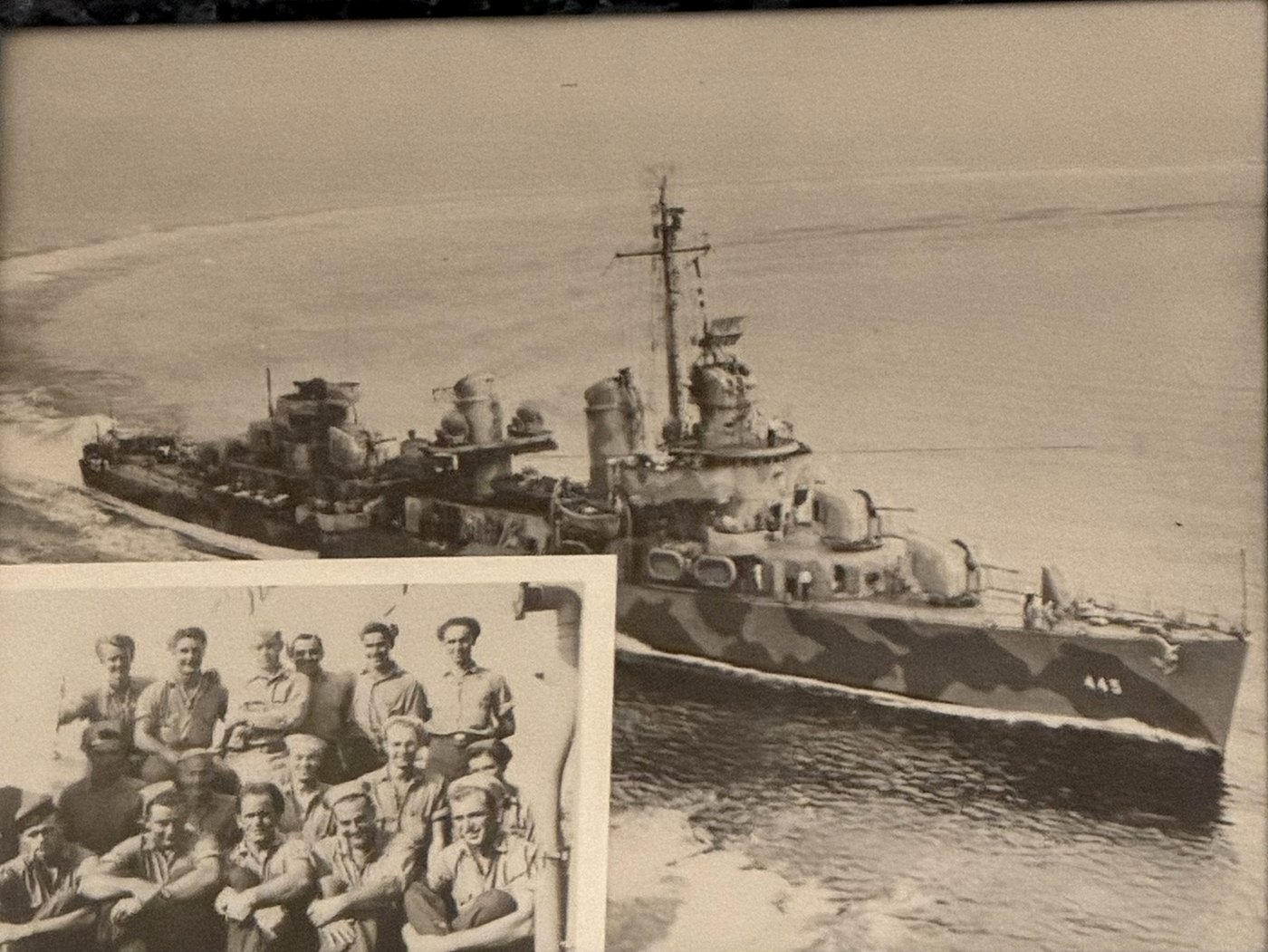
On December 11, 1942, his orders came through. He had twenty minutes to grab his gear and get aboard the USS Fletcher, the first of the Navy’s Fletcher-class destroyers. He served aboard the “Fighting Fletcher” for the rest of the war and was aboard for 13 of her 15 World War II battle stars.
The plotting room
Howard was a fire controlman, rising to Fire Controlman First Class. His battle station was the ship’s plotting room, deep inside the hull, where the fire control team ran the Mark 1A computer. Fed by the Mark 37 director above, it solved the problem of hitting a moving target from a moving, rolling ship and sent the aiming orders to the Fletcher’s five 5-inch guns.
He learned to play chess in the Navy, and later taught his son.
Her war, battle by battle
The Fletcher earned 15 battle stars in World War II. Howard was aboard for 13 of them. The first two of her great battles came before he reported aboard.
- ★ 1 · Oct 1942 – Feb 1943Capture and defense of Guadalcanal. Arrives at Nouméa on October 5, 1942, bombards Lunga Point on October 30, and spends the campaign on escort and patrol. Howard joins midway through.
- ★ 2 · Nov 12–15, 1942Naval Battle of Guadalcanal. Splashes several Japanese aircraft attacking the transports, then fights through the night surface action of November 13 that sinks two Japanese destroyers and cripples the battleship Hiei.Before Howard came aboard
- ★ 3 · Nov 30, 1942Battle of Tassafaronga. Leads the force through Lengo Channel, makes the first radar contact, then rescues hundreds of survivors of the cruiser USS Northampton using cork-floated cargo nets.Before Howard came aboard
- Dec 11, 1942Howard reports aboard the USS Fletcher with twenty minutes’ notice.
- Feb 1, 1943Takes aboard survivors of the destroyer USS De Haven, sunk by Japanese aircraft off Savo Island.
- ★ 4 · Feb 11, 1943Anti-submarine operations. Alerted by a smoke float dropped by a plane from the cruiser Helena, attacks and sinks the Japanese submarine I-18.
- ★ 5 · Feb–Mar 1943Consolidation of the Southern Solomons. Supports the Russell Islands landings on February 28 and bombards Munda airfield, New Georgia, on the night of March 5–6.
- Apr–Sep 1943Rest and refit in Sydney, Australia, then an overhaul in the United States.
- ★ 6 · Nov–Dec 1943Gilbert Islands. Screens a carrier task group for the invasion, including Tarawa, and fights off Japanese air attacks on November 26 and December 4.
- ★ 7 · Jan–Feb 1944Marshall Islands. Bombards Wotje on January 30, screens the Kwajalein landings, joins the bombardments of Taroa and Wotje on February 20–21, then patrols off Eniwetok.
- ★ 8 · Apr 1944Hollandia, New Guinea. Bombards Ali and Seleo Islands on April 23 and covers reinforcement landings at Humboldt Bay on April 30.
- ★ 9 · May–Jun 1944Special operations with Task Group 30.4. Anti-submarine patrols out of Nouméa.
- ★ 10 · Jun–Sep 1944Western New Guinea. Patrols against Japanese reinforcement of Biak, then covers and bombards for the landings at Noemfoor, Sansapor and Morotai.
- ★ 11 · Oct–Dec 1944Leyte. Screens the transports for the first landings on October 20, returns with reinforcements on November 23, and joins the destroyer sweep of Ormoc Bay in early December.
- ★ 12 · Dec 1944 – Jan 1945Luzon. Fires pre-landing bombardments for Mindoro, then covers the Lingayen Gulf attack force, shooting down at least one Japanese aircraft on January 8.
- ★ 13 · Jan 29 – Feb 17, 1945Manila Bay. Supports landings at San Antonio, Subic Bay and Nasugbu, then bombards Corregidor and Bataan. Hit by a shore battery on February 14.
- ★ 14 · Feb–Mar 1945Southern Philippines. Supports the landings at Puerto Princesa, Palawan, on February 28 and at Zamboanga, Mindanao, in March.
- ★ 15 · Apr–May 1945Tarakan, Borneo. Covers the minesweepers and the landings, then escorts and patrols in the Philippines until May 13.
- May 31, 1945Arrives at Terminal Island, Los Angeles, for overhaul.
Corregidor, February 14, 1945
At 1:26 that afternoon, while the Fletcher was supporting minesweepers at the entrance to Manila Bay, a hidden Japanese shore battery on Corregidor hit her forward. The shell burst at the No. 1 gun, killing men in the gun mount and the handling room below it and starting a fire in the No. 1 magazine. Watertender Second Class Elmer C. Bigelow went into the smoke-filled magazine without breathing gear and put the fire out. He died of his injuries the next day and was awarded the Medal of Honor. Within two minutes, the Fletcher’s remaining guns were firing back.
Eight of Howard’s shipmates died from that hit. Howard was on the crew that cleaned up afterward. He kept a steel shell fragment from the damaged area and, with his own hands, stamped it: CORREGIDOR FEB. 14 1945.
A blind date in Hollywood
LaVerne Pyzyna’s brother, 1st Lt. Adam Pyzyna, a B-17 bombardier, had been shot down over Yugoslavia in March 1944, evaded capture for 45 days, and returned to his unit, only to be killed in a B-26 landing accident in Florida in March 1945. LaVerne then moved with Adam’s wife, Elaine, from Chicago to Los Angeles and joined the defense effort at Northrop.
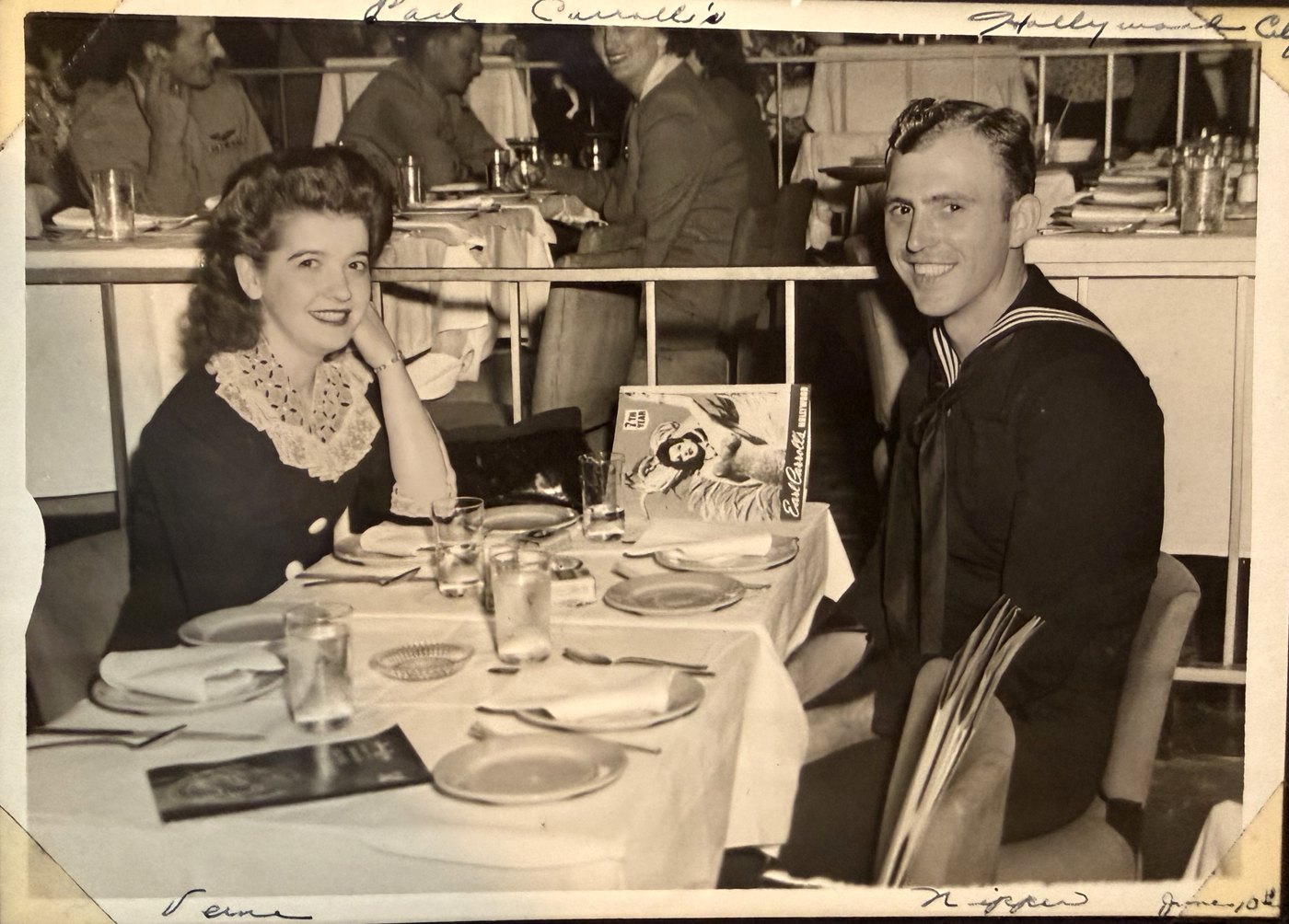
Ten days after the Fletcher reached Los Angeles, Howard and LaVerne met on a blind date at the Earl Carroll Theatre in Hollywood on June 10, 1945. They were married one month later, on July 10, 1945.
After the war
Howard kept in touch with his shipmates for the rest of his life. He attended the first USS Fletcher reunion in the Pocono Mountains in 1971, and later reunions in Nashville (1973), Baton Rouge (1991), where the group held a memorial service aboard the preserved Fletcher-class destroyer USS Kidd, and Dayton (1994), which the Knipp family helped host.
Among his keepsakes was a Navy life vest, given to him by a pilot grateful to Howard for “fishing him out of the water.”
This chapter is a work in progress. More photographs, documents and stories will be added.
Sources
- Dictionary of American Naval Fighting Ships, “Fletcher I (DD-445),” Naval History and Heritage Command.
- USS Fletcher Combat Action Report, Manila Bay Operations, 13–17 February 1945 (Serial 020), courtesy of the USS Fletcher Reunion Group.
- USS Fletcher Reunion Group, history and reunion records, ussfletcher.org.
- World War II battle star list for USS Fletcher (DD-445), MaritimeQuest warship directory.
- Family photographs, letters and recollections.