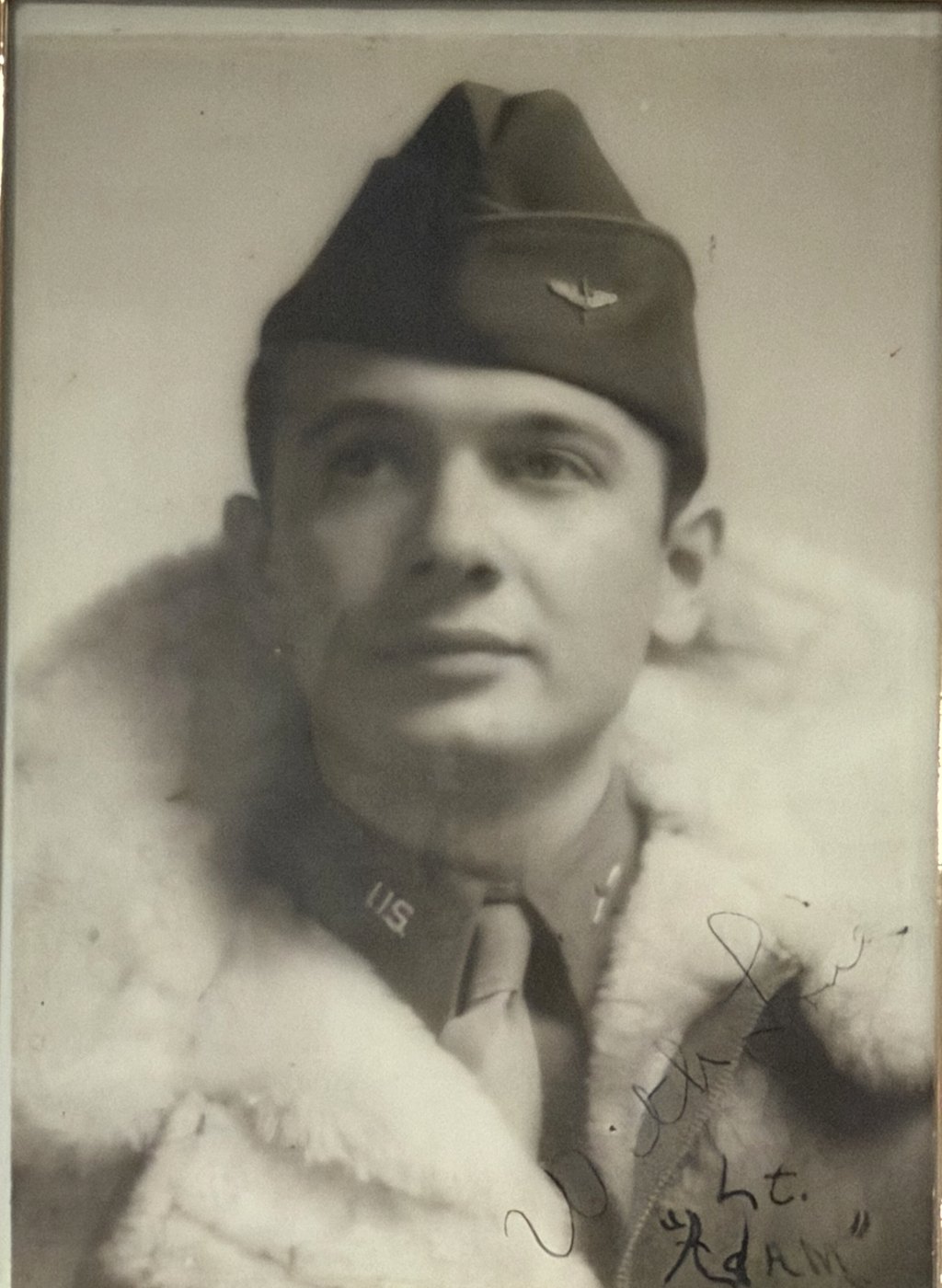
Adam Joseph Pyzyna of Chicago was LaVerne Pyzyna’s brother. He entered the service in the fall of 1941, trained as a bombardier, and in late 1943 went overseas to fly B-17 Flying Fortresses from southern Italy. He married Elaine, a Chicago girl, before he left.
A present by parachute
On December 4, 1943, bound overseas, Adam’s bomber passed over Chicago. He had made a small parachute out of a handkerchief, fastened his silver bombardier’s wings to it with a note giving directions for delivery, and dropped it over the city.
It landed in some bushes, where it lay until a party of hunters found it and followed the note’s directions. Just before Christmas the little parachute and the wings reached Elaine, then 19. The Acme Newspictures wire service photographed her holding it, and the story ran in newspapers across the country under the headline “Present by Parachute.” Elaine, the caption said, thought she was “the only girl in the world who got her Christmas present by parachute.”
Twenty-six missions
Adam joined the 20th Bomb Squadron of the 2nd Bomb Group, based at Amendola, a wartime airfield about 12 miles northeast of Foggia, Italy. He flew as bombardier on the crew of 1st Lt. Williard O. Butler Jr., in B-17G serial 42-31749.
Their missions ranged from targets in Italy to deep raids into Austria and Germany. On February 24, 1944, the crew flew in the group’s first wave to the aircraft parts factory at Steyr, Austria. Fighters attacked the formation for an hour, and the 2nd Bomb Group lost 14 bombers, its worst day of the war. Butler’s crew came home. Missions like Steyr counted double toward a combat tour.
March 18, 1944
The target was the German airfield at Villaorba, near Udine in northern Italy. The P-47 fighters assigned to escort the group never arrived. German fighters attacked the formation for more than half an hour before the target and again after the bombs were dropped. Twin-engine Ju 88s stood off behind the bombers, out of range of their guns, and fired rockets into the formation.
“I believe the third or fourth rocket sustained a direct hit on the tail section of plane #749 and exploded on contact. The explosion destroyed the left horizontal stabilizer and most of the vertical stabilizer. Plane #749 immediately made a violent nose-up that resembled a chandelle. It then went into a falling leaf spin.”
— T/Sgt. Raymond L. Terrell, 20th Bomb Squadron, an eyewitness in the formation
At about 10:15 in the morning, at 24,000 feet, the tail of Adam’s bomber was blown completely off. The plane fell in a tight spin. Adam fought his way out of the escape hatch, and his parachute opened only about a minute before he came down in a tree. He was the only survivor. The tail landed about a half hour’s walk to the south, and the rest of the plane crashed near the village of Gerovo, in the mountains of what is now Croatia. The people of Gerovo buried the crew in a funeral at the village church, brought flowers, and marked each grave.
The crew of B-17G 42-31749
- 1st Lt. Williard O. Butler Jr., pilot — killed
- 2nd Lt. Robert R. Drake, co-pilot — killed
- 2nd Lt. Charles A. Evert, navigator — killed
- 2nd Lt. Adam J. Pyzyna, bombardier — evaded
- S/Sgt. Martin C. Hutchinson, engineer and top turret — killed
- S/Sgt. Paul R. Henderson, radio operator — killed
- S/Sgt. James L. Hawton, ball turret — killed
- S/Sgt. Cantello H. Strickland, right waist — killed
- S/Sgt. Andrew M. McCrossan, left waist — killed
- S/Sgt. Horace B. Maddux, tail gunner — killed
Forty-five days with the partisans
Adam had left his escape kit, with its food, in the plane. He still had his map, compass and escape purse, and the Air Forces later credited them with his safe return. For two days he walked south-southwest through snow about five feet deep, sleeping in the open and eating only a few dextrose tablets.
At a peasant house he found an old man and a young girl, who sent him to the partisan village of Podkilavac. There, in house No. 80, his clothes were cleaned and he was fed and allowed to rest. The house belonged to Šimun Maganja, a partisan organizer of the Grobnik uprising. Partisans then took him to a camp about 4 kilometers away and, that night, on a twelve-hour march to Gerovo, where his crew lay buried. There he joined twelve other American airmen in the care of an English-speaking partisan the Americans knew as “Turk.”
- Mar 23–26By truck and wagon to Delnice, where the party stays three days.
- Mar 26 – Apr 2By wagon and on foot to Mrkopalj, then on to Drežnica. Unable to get across an enemy-held railroad and road, the party is forced back to Mrkopalj.
- Apr 6–9German aircraft bomb and strafe Mrkopalj. The party moves to Delnice, then Brod Moravice, now with 50 to 55 Americans, and by a roundabout route to Metlika, where more Americans join.
- Apr 11–15Around the north and east of Karlovac, within sight of Zagreb, then south between Karlovac and Sisak to Slunj.
- Apr 17By truck to Mazin. When the Germans attack the village, the party escapes into the mountains, where they meet Allied officers Major Jones and Lt. Col. Moore.
- Apr 21–22Through Martin Brod to Drvar and on to Petrovac.
- May 2, 1944Flown out by C-47 to Italy, 45 days after he was shot down.

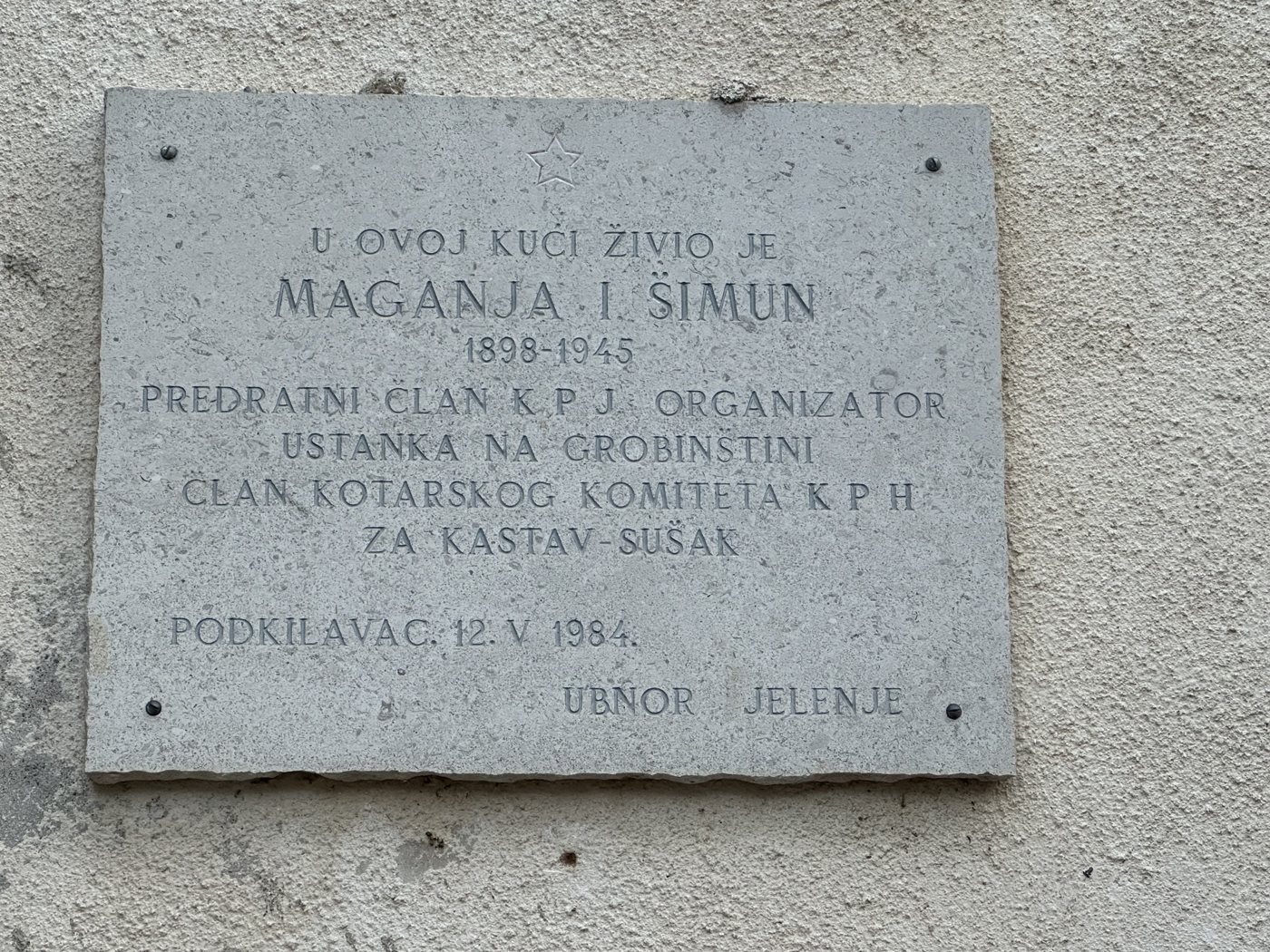
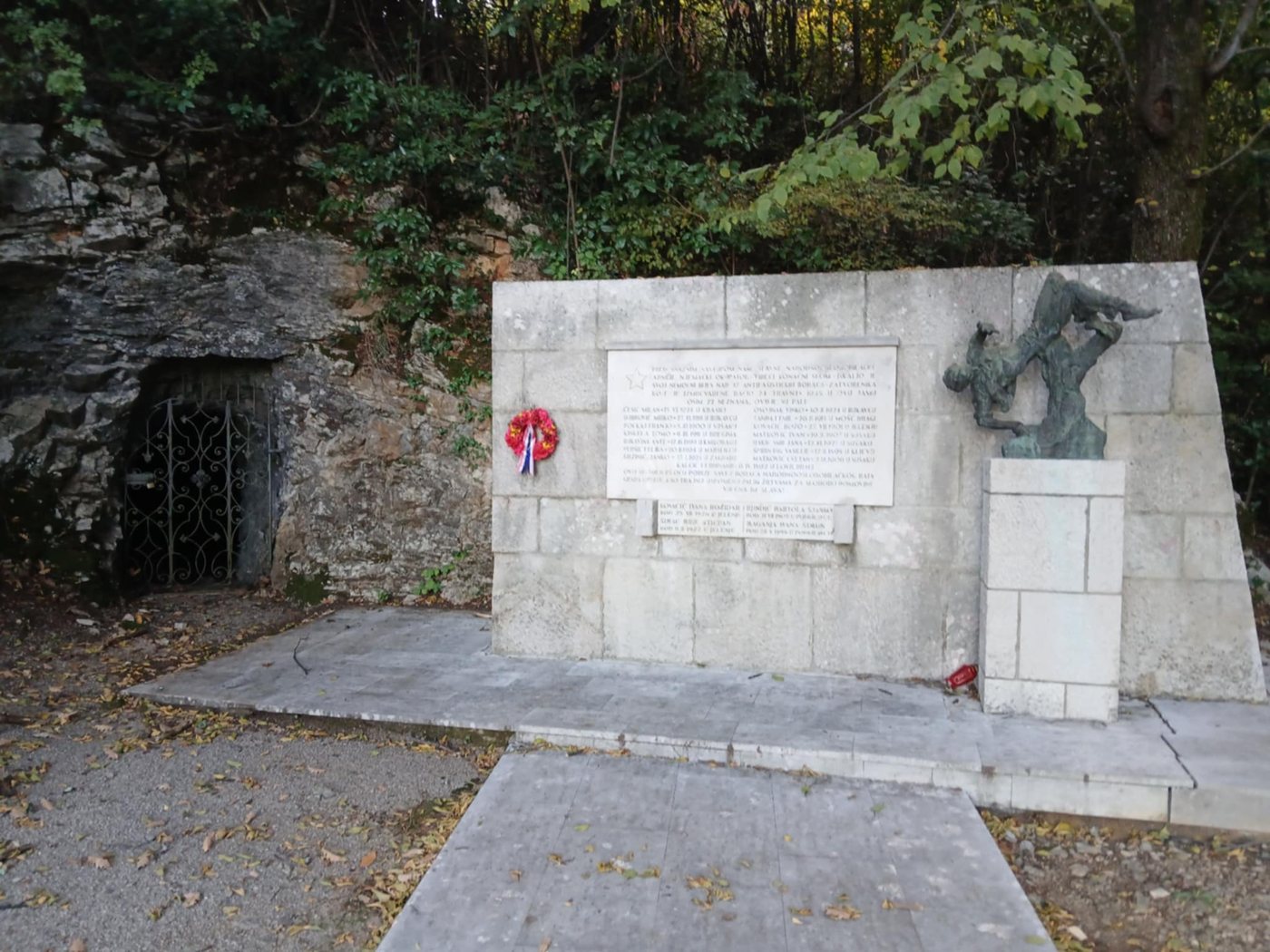
Šimun Maganja did not live to see the end of the war. In April 1945 he was among 37 anti-fascist prisoners executed and thrown into a pit near Opatija. His name is on the memorial there.
Back to the squadron
Two days after he was flown out, on May 4, 1944, Adam was questioned at Fifteenth Air Force headquarters. The interrogating officer, Maj. John W. Richardson, wrote that Adam had “evidently received excellent escape briefings” and closed his report: “Good straight-forward story.” On May 6 Adam was back with the 20th Squadron, whose war diary recorded his return, his account of the crash, and the funeral the villagers of Gerovo had given his crew.
The Escape Statement
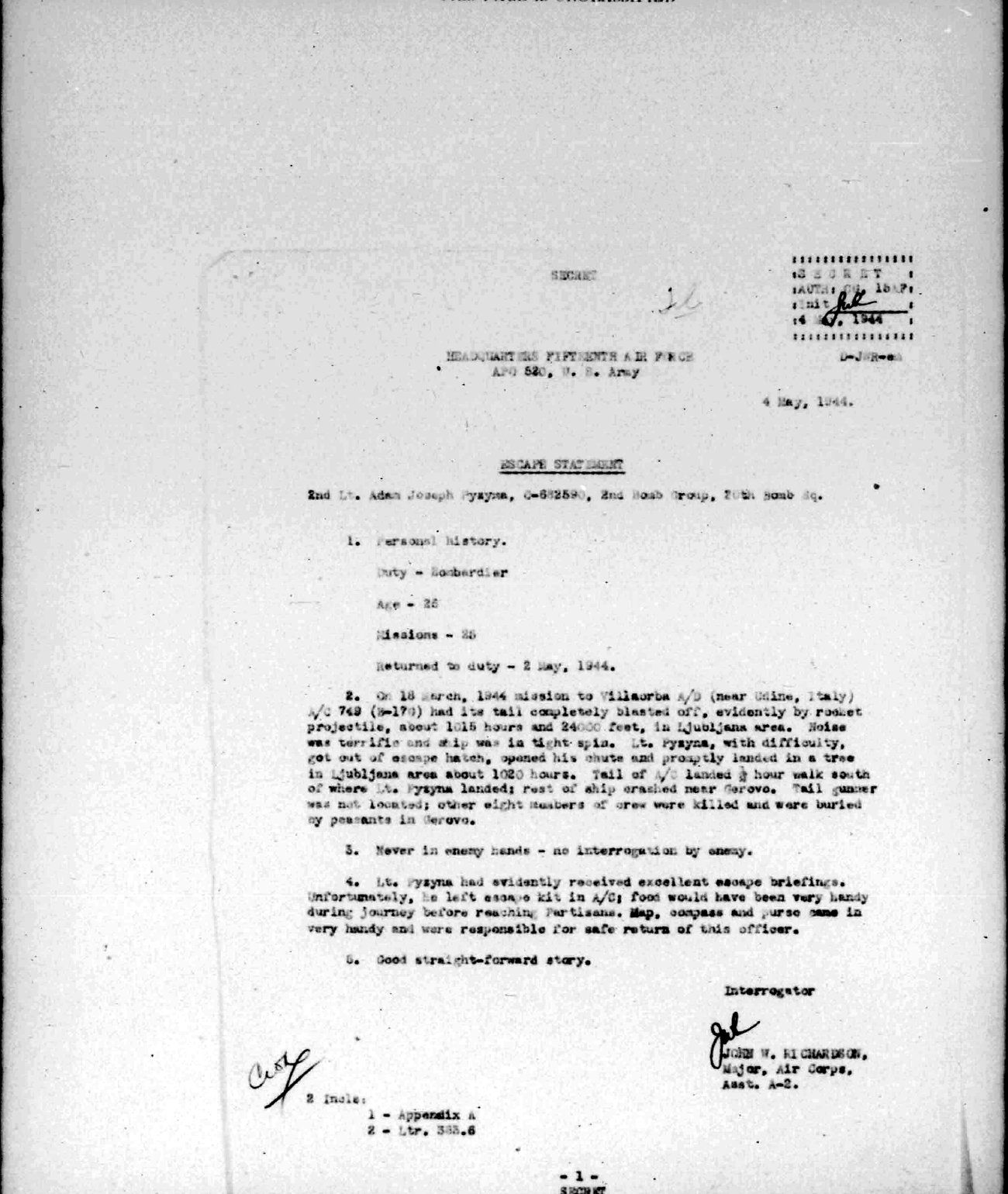
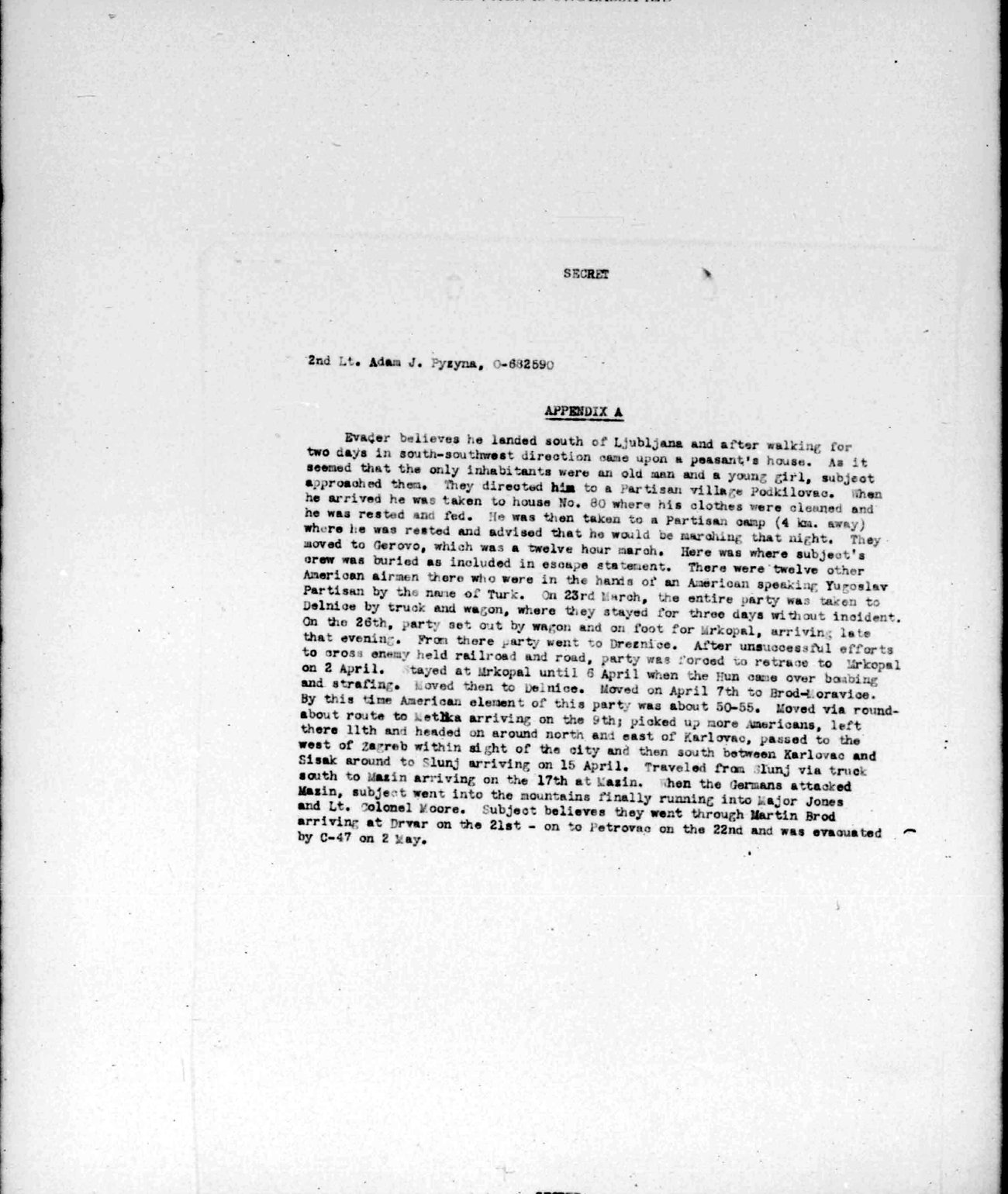
A transcription follows. Spellings of place names are as typed in 1944.
Kissimmee, Florida
By early 1945 Adam had been promoted to first lieutenant and was back in the United States, flying in B-26 Marauders. On March 5, 1945, at Kissimmee, Florida, the B-26 he was aboard collided on landing with a P-38 that had been cleared to take off on a crossing runway. Adam was killed. He had survived 26 combat missions, the destruction of his bomber and 45 days behind enemy lines, only to die at home, two months before the war in Europe ended.
Adam has no grave. In 1975 his sister Phyllis arranged for a government memorial marker for him at St. Adalbert Cemetery in Niles, Illinois. It reads simply “Adam J. Pyzyna” beneath a cross.
After Adam’s death, LaVerne moved with his widow, Elaine, from Chicago to Los Angeles, where LaVerne went to work at Northrop. That is where she met Howard Knipp, on a blind date, in June 1945.
The wreckage today
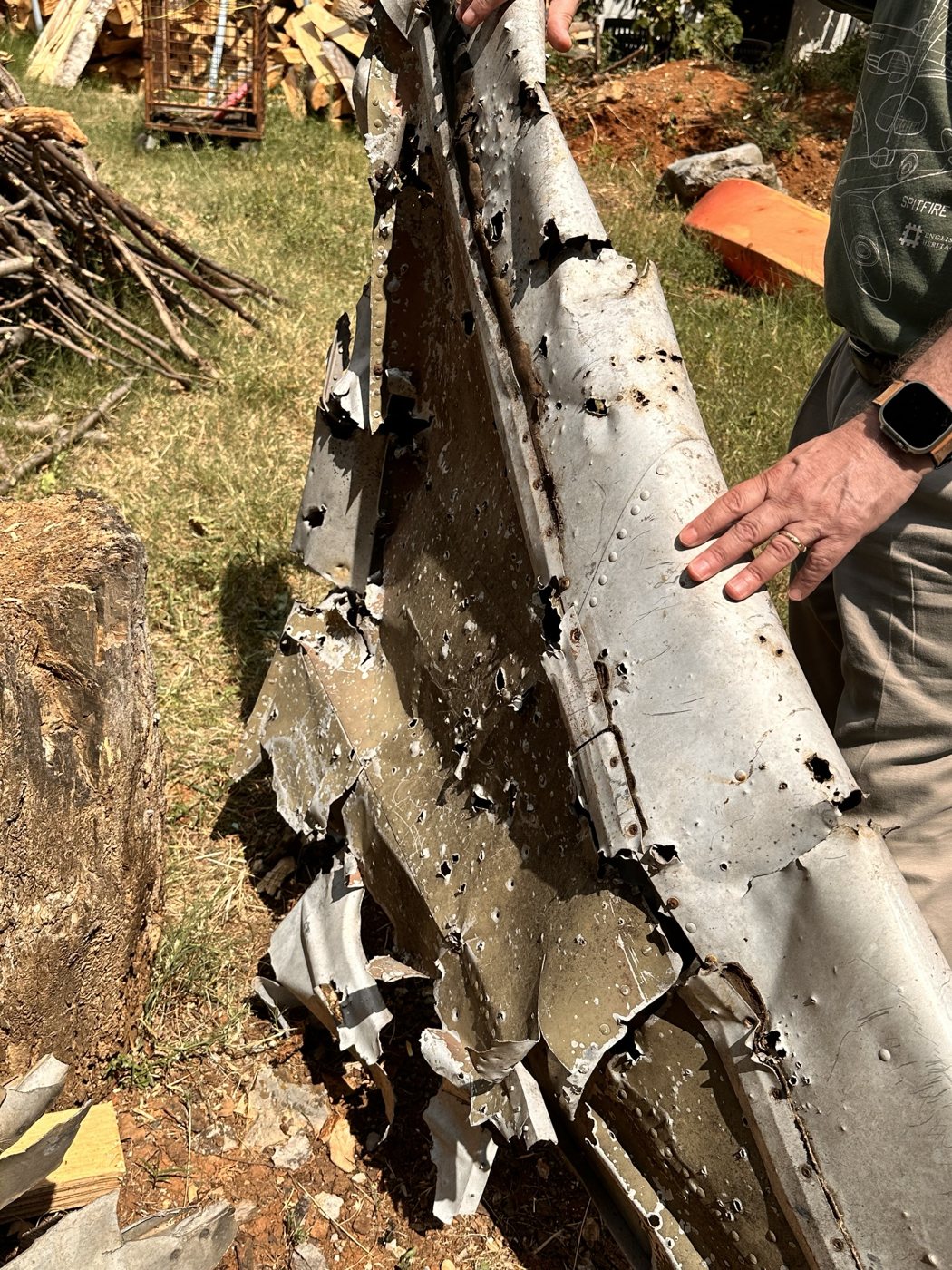
Parts of 42-31749, including the tail section that was blown off by the rocket, have been recovered from the mountains near Gerovo by a local researcher in Croatia. In August 2025 the family traveled to Croatia, saw the wreckage, and found the Maganja house in Podkilavac where Adam was taken in.
This chapter is a work in progress. We are still gathering photographs of Adam and Elaine, the official report of the Kissimmee accident, and more of Adam’s story.
Sources
- Escape Statement, 2nd Lt. Adam Joseph Pyzyna, Headquarters Fifteenth Air Force, May 4, 1944, with Appendix A. Air Force Historical Research Agency microfilm. Declassified.
- War Diary, 20th Bomb Squadron, 2nd Bomb Group, May 1944.
- Missing Air Crew Report 3257, B-17G 42-31749, including the statement of T/Sgt. Raymond L. Terrell.
- The Second Was First, history of the 2nd Bomb Group: Missions 150 (Steyr, Feb. 24, 1944) and 162 (Villaorba, Mar. 18, 1944).
- Acme Newspictures, “Present by Parachute,” Chicago Bureau, December 27, 1943.
- VA Application for Headstone or Marker, Adam J. Pyzyna, 1975.
- Memorial plaques in Podkilavac and near Opatija, Croatia; family visit, August 2025.
- Family records and recollections.